
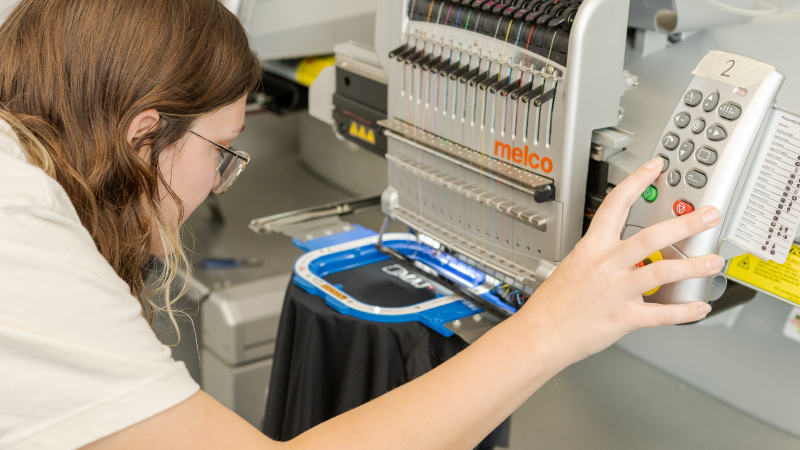
Why More Embroidery Stitches Do Not Always Mean Better Quality
One of the biggest misconceptions about embroidery is that more stitches automatically mean better quality.
They do not.
After more than 20 years producing embroidered apparel for Kansas City businesses, schools, teams, and organizations, we have seen heavily stitched logos that looked stiff and distorted. We have also seen simpler designs look clean, professional, and hold up for years.
Quality comes from using the right stitches in the right way.
When you add your logo to hats, polos, jackets, uniforms, or workwear, the finished piece represents your brand. The colors should look clean. The details should be easy to recognize. The garment should remain comfortable, and the custom embroidery should hold up through regular wear and washing.
That depends on much more than stitch count.
It depends on the logo, garment, fabric, size, placement, backing, and how the artwork is digitized before it ever reaches the embroidery machine.
Understanding these details can help you make better decisions and avoid common problems like puckering, stiff designs, unreadable lettering, or logos that pull the garment out of shape.
What Is Embroidery Stitch Count?
Stitch count is the total number of stitches required to complete an embroidered design.
Before a logo can be embroidered, the artwork must be converted into a special stitch file. This process is called digitizing.
Digitizing tells the embroidery machine:
- Where to place each stitch
- Which direction the stitches should run
- How dense each section should be
- When to change thread colors
- How the design should move across the fabric
- Where the machine should start and stop
A small, simple text logo may require only several thousand stitches. A larger or more detailed design can require tens of thousands.
But the goal is not to fit as many stitches as possible into the logo.
The goal is to use the correct number of stitches for the design, garment, and placement.
Why the Right Stitch Count Matters
Stitch count affects four important parts of the finished product:
- How the logo looks
- How the garment feels
- How well the fabric holds its shape
- How long the embroidery lasts
Too few stitches can leave areas looking thin, uneven, or incomplete. Small details may disappear, and lettering can lose definition.
Too many stitches can create a different set of problems. The embroidery may feel stiff, the fabric can pucker, and the logo may pull the garment out of shape.
We sometimes see logos that were overbuilt because someone tried to preserve every detail from the original artwork. The stitched version may technically match the file, but it does not always look or feel right on the garment.
A good embroidery job is not about maximizing stitch count.
It is about finding the right balance.
The Same Logo May Need a Different Setup
One of the most important things customers should understand is that the same logo may need to be adjusted for different garments.
A structured hat is not the same as a lightweight performance polo.
A heavy jacket can support a different embroidery setup than a soft quarter-zip.
A work shirt worn and washed several times a week has different needs than an event hat or seasonal jacket.
We have seen the same logo perform beautifully on a structured garment and poorly on a lightweight shirt because the original stitch file was reused without being adjusted for the fabric.
The logo may not have changed.
The garment did.
That is why an experienced embroidery team considers:
- Fabric weight
- Fabric stretch
- Garment construction
- Logo size
- Placement
- Backing or stabilizer
- Stitch direction
- Thread density
Lightweight or stretchy fabrics usually require more care. If the design is too dense, the material may wrinkle or pull around the logo.
Stable fabrics can often support more detail, but the setup still needs to match the garment.
Digitizing Is Where Embroidery Quality Starts
Embroidery does not work like printing.
A logo has to be translated into thread.
That means artwork designed for a website, business card, vehicle, or social media profile may not be ready for embroidery.
Small lettering that looks clear on a computer screen may close up when stitched. Thin lines can disappear. Gradients cannot be reproduced in thread the same way they appear in digital artwork.
Sometimes the most professional result requires simplifying the logo instead of forcing every detail into the design.
Good digitizing controls:
- Stitch direction
- Thread density
- Detail clarity
- Fabric movement
- Logo shape
- Lettering
- Final durability
One of the most common requests we receive is to embroider very small text exactly as it appears in a digital logo.
Sometimes that is possible.
Other times, increasing the logo size, simplifying the wording, or removing a small tagline creates a much cleaner result.
A good embroidery partner should be willing to tell you when your logo needs to change.
That conversation can prevent an entire order from being produced with lettering nobody can read.
How Logo Size and Placement Affect the Result
Logo size has a major effect on embroidery quality.
A detailed logo that looks great at four inches wide may lose clarity when reduced to two inches. Small text, thin lines, and tight spacing become harder to reproduce as the design gets smaller.
Placement also matters.
A left chest logo has different space limitations than a large back design. Hats have curved surfaces and seams that affect how the design can be stitched. Jackets, polos, and work shirts each sit differently in the hoop.
Before production begins, it is important to consider:
- How large the logo needs to be
- How much detail it contains
- Where it will appear
- Whether the garment can support it
- How the design will look from a normal viewing distance
The goal is not simply to fit the logo into the available space.
The goal is to make it look intentional and easy to recognize.
How Stitch Count Impacts Cost
Stitch count can affect embroidery pricing because more stitches require more machine time, thread, and production work.
But reducing stitch count should not be the main goal.
The real goal is improving efficiency without sacrificing the appearance of the brand.
Sometimes simplifying a design can reduce cost and improve the finished result at the same time.
For example, a logo with tiny text, gradients, shadows, or excessive detail may not translate well into thread. Cleaning up the design can create sharper embroidery while also reducing unnecessary stitches.
That does not mean your brand has to lose its identity.
It means the artwork is being adapted for a different medium.
A good embroidery partner will help you make those decisions before production begins.
Durability Comes From the Right Setup
Great embroidery should look good long after the first wear.
Proper stitch density helps the logo keep its shape through regular use and washing. The correct backing helps stabilize the fabric. Good digitizing helps prevent sections from pulling apart or becoming distorted over time.
The garment’s purpose should guide the setup.
Embroidered workwear may be washed frequently and exposed to tougher conditions. Polos may be worn weekly by customer-facing employees. Hats may be used outdoors. Jackets may need to last through several seasons.
The embroidery should be built for how the item will actually be worn.
That is why appearance, comfort, and durability all need to be considered together.
What to Know Before Placing an Embroidery Order
You do not need to understand every technical detail before ordering.
It does help to bring the right information to your embroidery partner.
Be prepared to explain:
- What item the logo will appear on
- How the garment will be used
- Where the logo should be placed
- Your preferred logo size
- Your quantity
- Your deadline
- Whether the artwork can be adjusted
- Whether you may reorder the same items later
It also helps to ask:
- Is my logo suitable for embroidery?
- Will the small text remain readable?
- Should any part of the design be simplified?
- Is this garment stable enough for the design?
- What size and placement will work best?
- What will I approve before production?
A digital proof can help confirm the general size, placement, thread colors, and artwork arrangement.
However, a digital image cannot always show exactly how the embroidery will feel or how very small details will appear in thread. That is why experienced production guidance still matters.
Custom Embroidery Done Right in Kansas City
From embroidered polos for Kansas City sales teams to hats for local events and durable workwear for trade crews, every project has different needs.
For more than 20 years, Custom Graphics KC has helped local businesses, schools, teams, churches, nonprofits, and organizations create branded apparel that looks professional and holds up.
We understand that your logo is more than artwork.
It represents your business.
Whether it is going on hats, polos, jackets, quarter-zips, workwear, or uniforms, we take the time to make sure the design, stitch count, garment, and placement work together.
If your logo is not ready for embroidery, that is not a problem.
Ready to experience responsive local service and premium custom embroidery? Start your quote with Custom Graphics today.
